1 Sept 2020

General-Characteristics-of-Twentieth-Century

A BRIEF NOTE ON HISTORICAL BACKGROUND

The Victorian era dates from 1837(with accession of Queen Victoria) and ends on 1901 with the queen's death.

In Victorian era, Victorians were more rigid(confining to unshakable institutions) living conventionally, realistically but with sophistication. What was said, not practised by them. So those were more contempted by the modern age writers.

In response to victorianism, we're having modernism like aspect of living life.

GENERAL CHARACTERISTICS OF TWENTIETH CENTURY

The half century of the 'twentieth century' is overshadowed by two world wars. As war doesn't bring good, similarly was happened, consrquently in first and second world wars. The latter had more devastating effect than prior one and its repurcussions in the form of post-war were found in frustration, unemployement of the people and the nation. So it is said that "the 1930s phenomenon reflected in aftermath of second world war.

ENQUIRING TENDENCY

This age was an age of 'questioning' and 'enquiring'. Unconcerned of any subjects, subject wasn't passed without examination and if then in G. B. SHAWS words it was considered as mere 'dogmatism' and he is also attributed for giving "a generation of interrogation abroad". While H. G. WELLS's and other writers's contributions is as usual, atleast covering some of the parts of the subject areas and contributing likewise.

As a result we had 'Bloomsbury group' whose writers(Virginia Woolf, Leonardo Woolf, Vanessa, E. M. Forster etc) were involved in conversation, carrying on one another's home and hammering out a new idea. But had a contemptuous tendency of nature for trivial thinking people.

Instead of 'Art for art's sake' art for life's sake was emphasized. Which was working only for the sake of community and human good(Ref. Mathew Arnold: The study of poetry-art for life's sake).

As a result many supportive and opposite movements had taken place and played their parts in human life as well as in shaping society.

MASS PRODUCTION AND INDUSTRIAL DISASTER

The poor people and working classes had emerged out, during 1930s. Where unemployment was a big question. The poor people and their condition were focused and decided to fought out collectively with such situations, so they can come out of such trauma and better their life. While the increasement in money value had more challenged their surviving chances.

In addition to this due to mass production kind of approach, technological and mechanical aspects were taken into consideration and obviously the poeple who weren't well equipped with such instruments were thrown out.

Parallely 1930s and 1990s can be compared.

For Example

Modern Times(1936)

The Great Dictator(1940)

Refering to the latter one, the first world colonized the third world, through the economic control and immigration had taken place.

Due to immigration, a bulk of literature was produced by third world writers as well as through some of the first world writers.

As a result world banks and monetary funding at world level had opened up to done its part but not by being impartial.


HUMAN HOPELESSNESS

Due to mass production, people of this particular era weren't much adaptive and mechanised as such, that they failed to give their best and industrual disaster happened. Which aroused the necessity of roti, kapda and makan and rather than retaining hope they weren't any option.

For Example: Mathew Arnold's hopefulness in opposite to James  Joyce Ulysses Moly's faintness(Post-Modernism era).
In this manner the very thing of "human hopelessness can be seen, by giving it the beginning of hopefulness.

THE LITERATURE OF MODERN AGE

As the very age was influenced by the two world wars, obviously it had been comprising the elements of wars, psycology, sex, experiments, innovation(Science and Technology/Materialism).

Due to the latter progressing area, vorticism, cubism and futurism like artistic movements had taken place. 

Along with this surrealism, dadaism, impressionism etc can be remembered.

Virginia Woolf Experimented with form, language and style and as a result James Joyce, Virginia woolf and many others had contributed in inventing "the stream of consciousness" literary technique for creating fiction, particularly for this age. Likewise H. G. Wells, Wilfred Owen, Samuel Butler, T. S. Eliot, Sossan, Henry Masefield, G. B. Shaw, William James and Freud(Psychology) contributed their parts in development of literature.


CONCULSION

The very tendency of Twentieth century was of enquiry, interrogation, innovations, invention and experimentation in Science and Technology. Though it had many advantages, It comprised disadvantages too. Those were long lasting and contributing more in human struggle and suffer and to come out one needs most spiritual mind and body.


WORKS CITED

Elt-Bilingualism-Trilingualism-Multilingualism

 An Experiment on three terms

Bi,Tri, Multi(lingualism)

Sample for experiment

Hello everyone,

I hope you all are fine,

After a very long time we all are meeting here.

See you all again!


Merhaba(Turkey) toutes les personnes(French),

espero(spanish)yuhaan sat(Sindhi) thik hain(urdu),

na(Dutch) meget lang tid(Danish), we traffas her(swedish).

다시 만나요.!


Thank you!


31 Aug 2020

Elt-Bilingualism-Trilingualism-Multilingualism


        ELT:     BILINGUISMO,                          TRILINGUISMO                                         MULTILINGUISMO.


 BRIEF OUTLINE OF ENGLISH            LANGUAGE IN INDIA

Prior to consolidation of 'British rule' in India, some sacred considered languages had been existing like; Persian, Urdu, Sanskrit which were dictating kings, mughals, badshahs etc.

When 'British rule' was consolidated in 1858, the advent of English language welcomed many campaigns and reforms in socio-politico and economic dynamics and there were many pioneers also, who have contributed in making new India.

When India got independence in 1947, the Britishers left 'the English language and it was the question of what role and status should be given to English language. As English language is of trade and finance, one can't also do away with it. Therefore this language was demanded by rulers to be utilized, and to manipulate and exploit majority of the people.

Thus the concept of first language(mother tongue, foster language, native, l1), second language (official{Hindi language}, l2) and Foreign language(second language, l3, associative or link language) came and so the concepts of Bilingualism, trilingualism and multilingualism are existing.


         WHAT IS BILINGUALISM

Generally if we see then, "the person, who knows two languages, is a bilingualist.

The manner of acquisition differs from person to person. It can be seen in compound, co-ordinating and relativity context.

In compound context, children would see in an object two signifiers, which actually has one signification.

For Example: A fruit toy: A child isn't having the sense of decipheration, through which he/she can see if it is literally a toy or a real fruit.

We may have some environmental, social, cultural aspects, relating to adoption of the child, the very parents who are belonging to different cultures or some working with co-ordination, concerning their languages.


It also can be seen in context of cognition. 

For Example: How a child, who remains in his/her ancestral environment is and the child, who is happened to adjust in another environment is.

In both the cases, languages and its acquisition will differ and both will have impact on their respective psycology. Through which their future performance can be seen.


        WHAT IS TRILINGUALISM

A person, who knows 'three languages' altogether. Where one can also see the elements of 'creole' and 'pidgin'.

Where we see sprinkle of other languages, simplistic approach towards language(norm of specific language) to mediate swiftly the ongoing communication etc.


For Example

 "Whatsapp Language": I m lessin/coming, ni8/nai ti etc..Where a new language can be invented.

     WHAT IS MULTILINGUALISM

A person, who is flexible with many languages. Which includes not only Indian languages, but also other foreign languages.

It isn't as such, as English is a global language and as internet has made the entire world, one. One can learn language through internet. But most times, it is happening that the person, who loves travelling, knows many languages as it seems to be somewhat practical approach, where a person can only adapt a language, remaining in particular environment.

For Example If we see 'Facebook' then the English language has served the purpose of link language, through which we all are united virtually, unconcerned of our respective language. While it is also giving such features to translate the foreign language, into any required regional or native language.

Bi,Tri, Multi(lingualism)

click here, to see a sample piece on these three terms.

Thus it seems to be step by step approach, as person befits him/her with as many langauges as he/she can, he/she becomes free to express his/her views without hesitation. While the respect towards any language and its respective culture is necessary to learn any new language.


               WORKS CITED

https://en.m.wikipedia.org/wiki/Indian_English

"Indian English." Wikipedia, wikimedia foundation, 30, August, 2020.

Vaidehi Ma'am:Online Lecture Classes.


7 Aug 2020

Epidemic-and-Me

How epidemic can affect a humanbeing?

For every humanbeing, any epidemic like situation is a "Rat's alley, where the dead men lost their bones" the voice is suppressed as humanbeing isn't having that much courage to speak and not having that loud voice as there is no room for stimulation. It is like: "Sweet Thames run softly for I speak not loud or long". But It happens at times, though we're as such but the surroundings as something which seems to be as "being for others" if given much importance, and if not it will have smooth way of running like "sweet thames".

The situation was like: "the living is now dead" and "those who were living are now dying with a little patience". For those who fail to retain hope for them the very situation is like hopelessness so they may succumbed to death and others in ignorance as failing to understand the situation, now dying with little patience and those who dictates the very notion of 'the survival of the fittest' like "Dr. Rieux" in the plague, "The white whale" in 'mobydick', "Mr. Utterson" in 'the strange case of Dr. Jeckyll and Mr. Hyde', "Santiago" in 'The old man and the sea' etc. If find there may be many examples as such, unconcerned of if it is whether fictional or non-fictional or based on day to day life. Those rather than succumbing to any tempted situation, will have its alternative to fight out and come out victoriously.

Having seen the outline above of corona crisis and epidemic, I would like to share my experience during lockdown, in poetic version...

Epidemic hasn't much affected my life, but It provided some outlook to look into the life. Epidemic can't only be characterized with the spread of disease, that is going to affect large  scale people. As it is related to infectious, it can be anything, prime thing which one can focus on is, if it is having the tendency of "affecting". Any situations, circumstances, influences can affect, negatively or positively. While it depends on the very tendency of human nature, how one can perceive this, and use it for specific outlet.

Epidemic Poetics
White ring, circling the deep blackening shadow;
Proceeding in dense, without the measuring whereabouts;
In an unending process,
Just bouncing back and forward, but not progressing ahead.
Approaching gradually,
A volcano comet, pierces into
Neither attracting nor detaching;
Remaining up slight from the surface level, pointing the target, swifts fiercely but patiently into the magnetic yet distancing forces;
That can't attract nor detach..

Thus was my experience that I came to confront in corona like situation. Which is actually the advent of realization in my life.


Thankyou..


Task: Remedial Coaching Pre-Task.


Sources:   Eliot, T, S., "The wasteland: 'the fire sermon-Phrases'". Published in December, 1922.


15 Jul 2020

A-Learning-Platform-TEDED

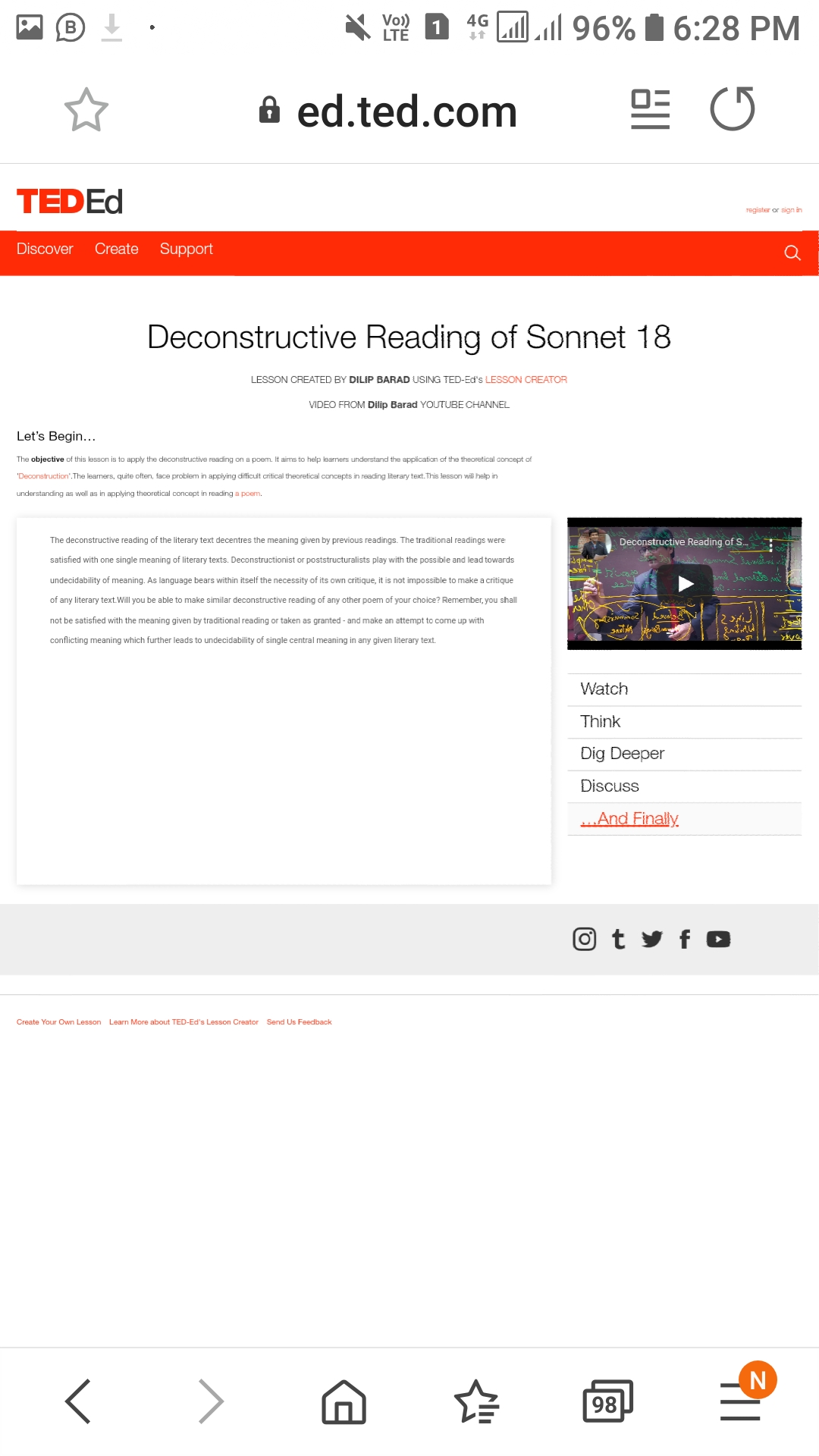
Having introduced with learning platform on Ted Ed by our Dilip Barad Sir. The experience was good as it opens many interconnected platforms for learning, those I have mentioned below. 
Opening each screen you will get different task to do, but interrelated with each other. It was first of its kind experience, where one can develop and hone different types of skills.

                              FIRST APPEARING SCREEN

APPEARING SCREEN
CLICK ON THE ABOVE SCREENSHOT TO EXPERIENCE LEARNING ON TED ED PLATFORM.

Opening the app, you will be introduced with this first page. Where you will see all details of the task. Five tabs under the video, through which you have to do your directed work.


1: WATCH SCREEN


2: THINK SCREEN


3: DIG DEEPER SCREEN


4: DISCUSS SCREEN

5: FINAL SCREEN

MORE FEATURES TO EXPLORE MORE..

If you yourself want to create your lesson, you can do as per the provided supoptions under the main option, as highlighted above.

The very essential and important feature of TEDED is DISCOVER(all are important, but I think it is the most needed feature in present times) where  as per your choice and conveniency you can discover and learn, in the form of provided lessons, series, earth school and blog.

Thankyou!


Deconstructive-Reading-on-Carol-Ann-Duffy's-Poem:Valentine


Deconstruction as a part of criticism, came into being after new criticism, probably in 1960's. Deconstruction found welcoming atmosphere in less political area  marked by skepticism and defeat. Four yale professors joined Derrida to publish a 'group of essays' "Deconstruction and Criticism(1979)" in United states. Two of the contributors became leading exponents; Paul De Man and J. Hillis Miller and other two Harold Bloom and Geoffrey H. Hartman were more interested in problematic relation of poets to their predecessors and their own language.
Since then it is used in various fields of knowledge and education. As it is based on 'western traditional philosophy' it seems as Derrida is trying to dismantle or subvert this very Philosophy to reconstruct it with new concepts, but it isn't so. Though it is trying to, but altogether it is also trying to unpack and disclose those over wrapped and layered strucutures, to make people aware of etymologically conventional and institutional aspects.
As such, I myself is trying to find those intentional relations, based on corelativeness, which is integrated in itself as a component and an intentional layer.
Wherein, in entire process, it isn't going to uproot the very word or meaning, but to try to find the conscious and suppressive rules, underlying in the text, which will in turn transform it into a new concept and a new idea. As a part of the text, it will be pieced into pieces, at surface level seems to be fragmented but gradually would gain a singularity through generalization. Eventually will become an independent new conceptual text. 


As it equates with democracy, it gives full freedom for hermenutics, regarding any literature, where not only the reader is free to convert the language into something else but more than that.
 
 The quote is: "Language Bears within itself the Necessity of its own Critique".

Let's see now a critique on Carol Ann Duffy's "Valentine".

On valentine's day, generally a beloved and suitor exchanges love, in form of red rose or something in red color. As it symbolizes love.

LITERAL MEANING OF THE POEM
If literally seeing this poem then there is a person, named(I) who is addressing (you) another person, who is just telling her(I give you an onion).

Where as per the(I) onion is having some qualities, which he has described, you can see in the poem. As poem is further unfolding, (I) is becoming (we) and it seems as already an experienced, one of the couple's members is sharing (her) experience from feminist point of view, denoting such volunteer attitude. If one likes one may have such experience of onion but its scent will cling to fingers and also to knife.

Perhaps meant to say that a girl/female/woman will only remain in four walls, where she might be doing the general things, the housewife is expected to do. Rather than this she can't even think about.
Keeping this things in mind, one can think further, if she wants this onion of reality or not.

DECONSTRUCTION OF THE POEM
Deconstructing the very poem, the prime focus of the poet is on "valentine's gift". A redrose(love, sacrifice death, marriage), satin heart (sophistication, superficiality, delicateness) to onion(hard, layered, real, dark) the poet centralizes focus on.

Onion is having its own story. It is a moon(wrapped in brown paper) that promises light like a careful undressing of love, blind with tears like lover. Describing onion as platinum loops, shrink to a wedding ring, and its scent cling to fingers cling to knife.

As we have seen how "onion" is in nature, from the view point of the poet. But as its description says it is a wrapped moon in brown cover, which promises light like a careful undressing of love. Is poet trying  to say that something is mysterious, hidden, covered up, though seems to be joy at first, but it is mere an aspect of love, which is just opened? Why such mystery? Why such hidden forces? Is it that something is as such that it will reveal gradually? Is it indicating towards some colonialism or imperialism aspects of History, where in the name of civilization, annihilation and destruction were carried out? Let's see.

Furthermore  the poem says it is blind with tears, suggest here vagueness, blurriness, which is actually like lover.

It has been revealed now, an onion is a lover.

As it is lover, it is now clear that this is male lover.

Does it suggest that the lover is possessing dual aspect of nature, which is different from what he seems to be and what actually he is?

Then suddenly the mind urge to see in flashback, who is describing such qualities of onion and the "I" comes into being. Is this a male or female(as one is describing such characteristics, seems to be sharing one's own experience or if having an evident experience of).

As it is saying "I'm trying to be truthful"! Is this mean 'she is just trying' while she isn't? Or just trying to stop someone from commitment for love relationship? Isn't it that third aspect playing role? Or something else..let's see further..
Suddenly then "I" transforms into "WE" and it gets reveal that it is based on poet's own experience. Through which the poet is trying to make aware that person, who wants to indulge in such relationship.

From the phrase "platinum loops shrink to a wedding ring, its scent clings to your fingers, cling to your knife". 

It finally reveals as onion is describing a 'relationship' which will open up one after another layer, shrinking just to wedding ring, it will only be limited to house chorus, especially for women here.

 onion seems to now suggest patriarchy, politics in relationship, gender discrimination, gender inferiority(especially concerning here female gender).
Patriarchy in sense, where female gender isn't given appropriate freedom, but expected to live in the power structures of society, where male gender is given due importance and respect.

As the poet also emphasize on  "here". Where perhaps, she is suggesting a specific place, a spot, a society, perhaps her own house and the poet herself is female and so she is narrating her own experience and putting forward, positive and negative aspects of relationship, as it is also having its limit and it should be followed as such.

NARRATIVE OF FRAGMENTED PIECES

"I": How I was swept into, don't know; a magic-like atmosphere was such, It rattled me with it, through unknown place. 
How it was at first,
Seeming as everything is here,
Don't want to go anywhere,
My heart was urging me to seize the moment,
As the atmosphere is, wasn't ever.
I was on nine clouds,
Perceiving myself as most luckiest in the world.
But what happened....
Was this life, for which I was craving?
It is now becoming dull and passive day by day, seems as the moment has seized somewhere,
Ashes is sprinkling, finding traces but not able to make it out!
How everything changed, or I got bored?
Seems as I was only here to eat onion and enjoying its scents..
Ain't I having feelings, emotions, wanting to live freely;
Then why restrictions, only on my part,
Being woman is crime,
We all are human beings and equal as per God;
Then why god I'm disqualified here?
Is this a different world from yours;
Or there also such things were prevailing,
Only I was ignorant of;
Why? Why God?
Now I'm helpless;
What I can do?
As I have spoiled half of journey of my life..
I can't see anyway;
It seems to be blur everywhere;
But I will now try to make appraise others!

"YOU": What I have thought, and  what it has  now become!
How fool I'm, how ignorant I'm that I wasn't knowing this!
How raw I was! Is it due to that sweet somber sprinkling of words, coming out of thoughtful mind? Was I prone to this fate! O gentle lady, how fortunate I'm to meet you!

"ONION": Whirling mustache! An eye around, inhaling; just treading forward, with horse-shoes, bragging point is mocking on him, nevertheless he is walking, a cast of abhorrent sight, stamping a shawl with pride, just furthering....

Perhaps in this way  or by critiquing and seeing each aspect or character in different manner, a criticism can be developed in progressive way.

Seeing all the narratives, the listener, who is seeing and observing everyone, will have to now decide  what she is suppose to do as representative of the society. Where she will marry her lover, or musing upon the woman's suggestions, she will decide to quit the marriage and be an exemplar for the society?..

CONCLUSION
Thus deconstruction is a form of different and altogether a new type of criticism, which rather than just giving surface meaning, provides unconscious and suppressed meanings, which had been thought by the concerned writer but as hesitating to openly share the thoughts, such things are layered out in this way.
While such a task and its manner of doing is introduced by Jacques Derrida. One of which I have carried out and tried to put my views on, through the mentioned poem.

Learning experience on TEDEd


Works Cited

Duffy, Carol A., "Poem: Valentine". Originally published in Mean Time(Anvil 1993). www.scottishpoetrylibrary.org.uk.
 
 To know more about deconstruction, click on the link: A commemorative symposium:Derrida/Deconstruction.


                                                            Thankyou..


23 Jun 2020

Emmanuel-Kant-Philosophy-Modernity-Intellectual-History-Eighteenth-Century


What is Enlightenment?(A small text or a slew of an essay by Emmanuel Kant)

Having watched and listened the mentioned video on Philosophy, Modernity and Intellectual history: "What is enlightenment". I'm writing my comprehensive understanding on it.

As the concept of enlightenment is based on philosophy and social movement, it reflects so. As the very definition of Enlightenment says: "The very project of enlightenment is to make the world more of a home for humanbeings(hospitable) and this is only possible through pure reason, which will reduce in turn its dangers and bringout potentiality". While not denying to believe in faith and belief.

It only can be made possible by merging the both "phenomenal(the world of Science) and noumenal(the world of faith / immortal soul)" and steering on the middle path. With its co-existence only poeple can be curious to know more of the world, be courageous, believe in immortal soul and pure reason, which will in turn also help to extract / built clear and distinct ideas.

For which he is also postulating two theories; one by Rene Descartes and another by John Locke. Where the former is based on Plato's assumption, "if idea has connection with real"? Which actually arises skepticism in mind. Basing his argument / sentence on skepticism, Descartes says, "I think therefore, I am". Which means according to Descartes, Everything around is doubtful.

For Example: If a person is seeing a bookcase / clock. What for him / her is thing, which he / she is seeing, can't be for another. Or say seeing from his point of view, can't be a bookcase but a square, sticked woodsticks, which has given it a wide rectangular shape.

It seems to be on surface level as the thinker is doubting, but actually isn't. He is saying, "I'm thinking" and the ideas and further theorums can be generated from this, basing on mathematics, science and calculation.

The another is based on "Empericism". Which says, it is all about experience, a person gets from the world, can be experimental, can be gained by constant sensation, a specific construction of mind to see the world. While Kant says, "Experience is a habit or custom".

Travelling in middle, Kant(a complex thinker)says that it must be steered between the two "Phenomenal" and "noumenal" and so he is having is cake and eating it too.


Bibliography


FEATURED POST

Journalism: #Lead-Writing #Feature-Writing

With the advent of information, journalism like concept came into being as a means to disseminate information; through newspapers , TV chann...