![]() |
All kind of academic related blogs based on thinking, creative, critical, analytical skills. Articles, Poems, Film Reviews, Quotes etc can be found here
15 Jul 2020
A-Learning-Platform-TEDED
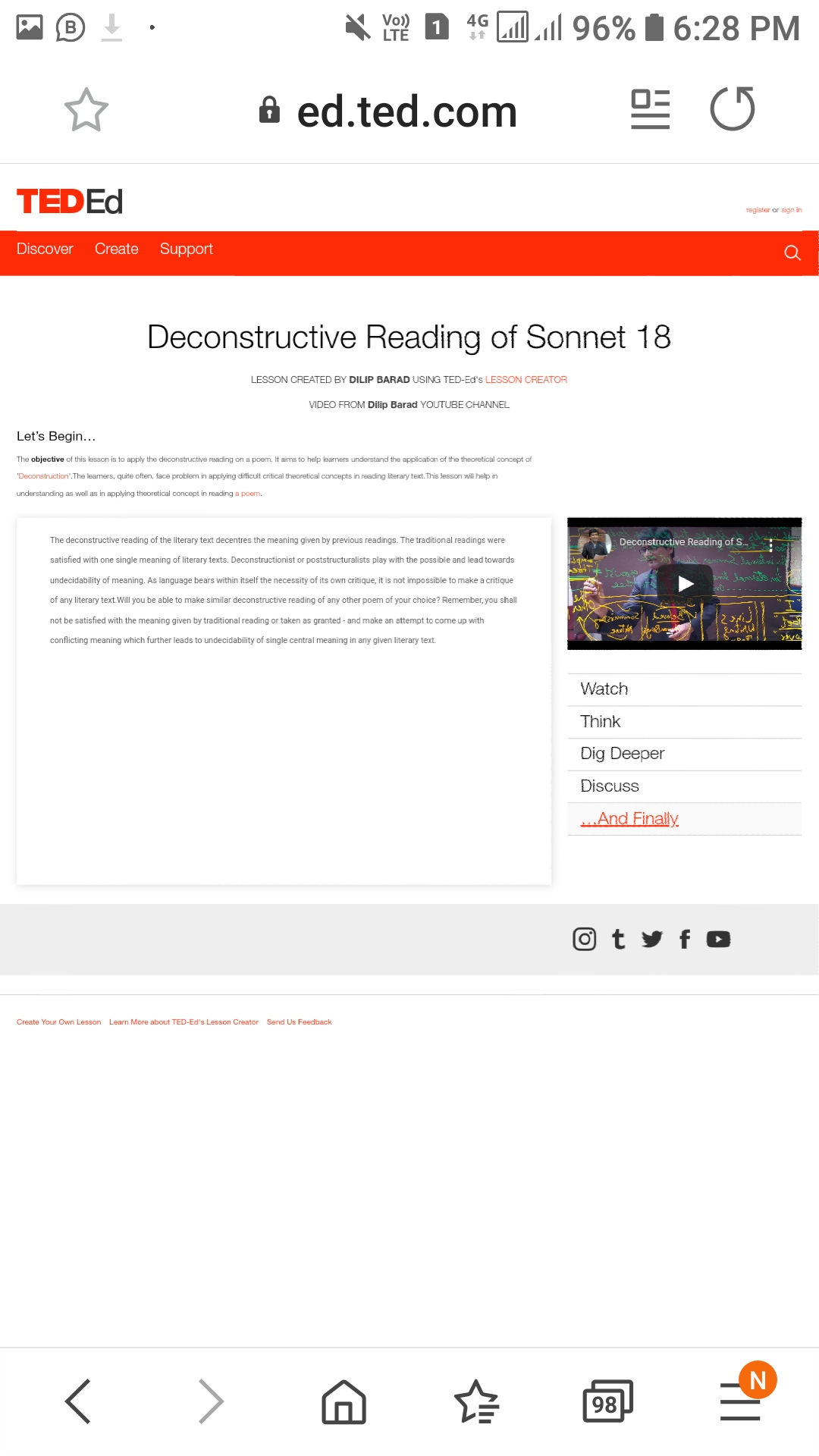
Deconstructive-Reading-on-Carol-Ann-Duffy's-Poem:Valentine
As it equates with democracy, it gives full freedom for hermenutics, regarding any literature, where not only the reader is free to convert the language into something else but more than that.
The quote is: "Language Bears within itself the Necessity of its own Critique".
![]() | |
| On valentine's day, generally a beloved and suitor exchanges love, in form of red rose or something in red color. As it symbolizes love. LITERAL MEANING OF THE POEM If literally seeing this poem then there is a person, named(I) who is addressing (you) another person, who is just telling her(I give you an onion). Where as per the(I) onion is having some qualities, which he has described, you can see in the poem. As poem is further unfolding, (I) is becoming (we) and it seems as already an experienced, one of the couple's members is sharing (her) experience from feminist point of view, denoting such volunteer attitude. If one likes one may have such experience of onion but its scent will cling to fingers and also to knife. Perhaps meant to say that a girl/female/woman will only remain in four walls, where she might be doing the general things, the housewife is expected to do. Rather than this she can't even think about. Keeping this things in mind, one can think further, if she wants this onion of reality or not. DECONSTRUCTION OF THE POEM Deconstructing the very poem, the prime focus of the poet is on "valentine's gift". A redrose(love, sacrifice death, marriage), satin heart (sophistication, superficiality, delicateness) to onion(hard, layered, real, dark) the poet centralizes focus on. Onion is having its own story. It is a moon(wrapped in brown paper) that promises light like a careful undressing of love, blind with tears like lover. Describing onion as platinum loops, shrink to a wedding ring, and its scent cling to fingers cling to knife. As we have seen how "onion" is in nature, from the view point of the poet. But as its description says it is a wrapped moon in brown cover, which promises light like a careful undressing of love. Is poet trying to say that something is mysterious, hidden, covered up, though seems to be joy at first, but it is mere an aspect of love, which is just opened? Why such mystery? Why such hidden forces? Is it that something is as such that it will reveal gradually? Is it indicating towards some colonialism or imperialism aspects of History, where in the name of civilization, annihilation and destruction were carried out? Let's see. Furthermore the poem says it is blind with tears, suggest here vagueness, blurriness, which is actually like lover. It has been revealed now, an onion is a lover. As it is lover, it is now clear that this is male lover. Does it suggest that the lover is possessing dual aspect of nature, which is different from what he seems to be and what actually he is? Then suddenly the mind urge to see in flashback, who is describing such qualities of onion and the "I" comes into being. Is this a male or female(as one is describing such characteristics, seems to be sharing one's own experience or if having an evident experience of). As it is saying "I'm trying to be truthful"! Is this mean 'she is just trying' while she isn't? Or just trying to stop someone from commitment for love relationship? Isn't it that third aspect playing role? Or something else..let's see further.. Suddenly then "I" transforms into "WE" and it gets reveal that it is based on poet's own experience. Through which the poet is trying to make aware that person, who wants to indulge in such relationship. From the phrase "platinum loops shrink to a wedding ring, its scent clings to your fingers, cling to your knife". It finally reveals as onion is describing a 'relationship' which will open up one after another layer, shrinking just to wedding ring, it will only be limited to house chorus, especially for women here. onion seems to now suggest patriarchy, politics in relationship, gender discrimination, gender inferiority(especially concerning here female gender). Patriarchy in sense, where female gender isn't given appropriate freedom, but expected to live in the power structures of society, where male gender is given due importance and respect. As the poet also emphasize on "here". Where perhaps, she is suggesting a specific place, a spot, a society, perhaps her own house and the poet herself is female and so she is narrating her own experience and putting forward, positive and negative aspects of relationship, as it is also having its limit and it should be followed as such. NARRATIVE OF FRAGMENTED PIECES "I": How I was swept into, don't know; a magic-like atmosphere was such, It rattled me with it, through unknown place. How it was at first, Seeming as everything is here, Don't want to go anywhere, My heart was urging me to seize the moment, As the atmosphere is, wasn't ever. I was on nine clouds, Perceiving myself as most luckiest in the world. But what happened.... Was this life, for which I was craving? It is now becoming dull and passive day by day, seems as the moment has seized somewhere, Ashes is sprinkling, finding traces but not able to make it out! How everything changed, or I got bored? Seems as I was only here to eat onion and enjoying its scents.. Ain't I having feelings, emotions, wanting to live freely; Then why restrictions, only on my part, Being woman is crime, We all are human beings and equal as per God; Then why god I'm disqualified here? Is this a different world from yours; Or there also such things were prevailing, Only I was ignorant of; Why? Why God? Now I'm helpless; What I can do? As I have spoiled half of journey of my life.. I can't see anyway; It seems to be blur everywhere; But I will now try to make appraise others! "YOU": What I have thought, and what it has now become! How fool I'm, how ignorant I'm that I wasn't knowing this! How raw I was! Is it due to that sweet somber sprinkling of words, coming out of thoughtful mind? Was I prone to this fate! O gentle lady, how fortunate I'm to meet you! "ONION": Whirling mustache! An eye around, inhaling; just treading forward, with horse-shoes, bragging point is mocking on him, nevertheless he is walking, a cast of abhorrent sight, stamping a shawl with pride, just furthering.... Perhaps in this way or by critiquing and seeing each aspect or character in different manner, a criticism can be developed in progressive way. Seeing all the narratives, the listener, who is seeing and observing everyone, will have to now decide what she is suppose to do as representative of the society. Where she will marry her lover, or musing upon the woman's suggestions, she will decide to quit the marriage and be an exemplar for the society?.. CONCLUSION Thus deconstruction is a form of different and altogether a new type of criticism, which rather than just giving surface meaning, provides unconscious and suppressed meanings, which had been thought by the concerned writer but as hesitating to openly share the thoughts, such things are layered out in this way. While such a task and its manner of doing is introduced by Jacques Derrida. One of which I have carried out and tried to put my views on, through the mentioned poem. Learning experience on TEDEd Works Cited Duffy, Carol A., "Poem: Valentine". Originally published in Mean Time(Anvil 1993). www.scottishpoetrylibrary.org.uk. To know more about deconstruction, click on the link: A commemorative symposium:Derrida/Deconstruction. Thankyou.. |
23 Jun 2020
Emmanuel-Kant-Philosophy-Modernity-Intellectual-History-Eighteenth-Century
What is Enlightenment?(A small text or a slew of an essay by Emmanuel Kant)
Having watched and listened the mentioned video on Philosophy, Modernity and Intellectual history: "What is enlightenment". I'm writing my comprehensive understanding on it.
As the concept of enlightenment is based on philosophy and social movement, it reflects so. As the very definition of Enlightenment says: "The very project of enlightenment is to make the world more of a home for humanbeings(hospitable) and this is only possible through pure reason, which will reduce in turn its dangers and bringout potentiality". While not denying to believe in faith and belief.
It only can be made possible by merging the both "phenomenal(the world of Science) and noumenal(the world of faith / immortal soul)" and steering on the middle path. With its co-existence only poeple can be curious to know more of the world, be courageous, believe in immortal soul and pure reason, which will in turn also help to extract / built clear and distinct ideas.
For which he is also postulating two theories; one by Rene Descartes and another by John Locke. Where the former is based on Plato's assumption, "if idea has connection with real"? Which actually arises skepticism in mind. Basing his argument / sentence on skepticism, Descartes says, "I think therefore, I am". Which means according to Descartes, Everything around is doubtful.
For Example: If a person is seeing a bookcase / clock. What for him / her is thing, which he / she is seeing, can't be for another. Or say seeing from his point of view, can't be a bookcase but a square, sticked woodsticks, which has given it a wide rectangular shape.
It seems to be on surface level as the thinker is doubting, but actually isn't. He is saying, "I'm thinking" and the ideas and further theorums can be generated from this, basing on mathematics, science and calculation.
The another is based on "Empericism". Which says, it is all about experience, a person gets from the world, can be experimental, can be gained by constant sensation, a specific construction of mind to see the world. While Kant says, "Experience is a habit or custom".
Travelling in middle, Kant(a complex thinker)says that it must be steered between the two "Phenomenal" and "noumenal" and so he is having is cake and eating it too.
Bibliography
5 May 2020
Albert-Camus-The-Plague-Literature-And-Epidemic
Albert Camus : The Plague(1947)
![]() |
| Literature & Epidemic This novel is based on 1899 "Cholera epidemic" which killed large proportion of Oran people, situated in 1940s. Introduction: In the days of Epidemics and pandemics, where many lives are striving to survive, to keep themselves safe from such infections, a new thing is seeking its share from humans, and that is literature. How literature being very sensitive and flexible part of life, contains everything in it. This is the test of time that how much time wanted us to tolerate such circumstances, there may be some limit. Without peeping into further past problems, let's now concentrate on how literature&epidemics have association with one another. Where every humanbeing is busy in hustle bustle of life, it is only the literature, which is inscribing freely everything, what human writes and in this sense, it is literally the test of time. |
22 Apr 2020
Jaques-Derrida-Deconstruction-Analysis-Education-System
![]() |
Anecdote on Deconstruction : Derrida observing building minutely and obsorbing the structure of the building, abruptly shared his observance with Rita. |
Derrida: Can you see this well constructed building? How it has been built! With proper elevation, structure, well furnishing from outside and inside, nicely colored and insulated, surrounded by garden and seems to be result of proper 'architectural planning', as the building says so..!
Rita: Are you sure, that what you are seeing, is actually a building? It seems to me something different as giving me an indication of absence of something, which perhaps you're unable to look in..
Derrida: Absence! Oh I got you perhaps you want to say that there must be a bungalow/apartment/duplex here..? But here it is building..
Rita: Not that absence. I am talking with reference to this building's being...!...
Derrida: You mean to say "being of this being(building)"? ..
Rita: yes..
Derrida: I got you!
...And he says that the absence of "sand, concrete, cement, bricks, wood, such materials useful in building a capacious and lavish building" are absent here, which I wasn't able to see, but indicated by you.
Comprehension on "Deconstruction"
Deconstruction can't be defined as said by "Derrida"(The very picture supports the idea of Deconstruction)But he says incase it can be defined then at what limits and what extent? Furthermore he says: this isn't a negative term but " an inquiry into the very foundations of western philosophy and the intellectual system, which is based on binary oppositions". But by rectifying he says that: he doesn't want to subvert the western philosophy as "Heideggar"(as they consider "being of beings" insignificant) wants, he only wants to transform the thinking of those people.Derrida also tries to persuade "Heideggar" a philosopher, to look into the system of philosophy, concerning "phonocentricism" rather than "writing". He says: "Logocentricism is manifestation of phonocentricism". While he himself in his book on Grammatology, emphasises on "writing rather than on speech".
As we move further we also see that there isn't audible difference between "to differ & to defer" but in terms of spelling and writing it has difference. It is a new coined termed which Derrida has taken from German to French. While in English it is as "difference". But difference doesn't imply anything rather than "force" and "force" is suggestive of "differentiation" which keeps the word's meaning postponed rather than giving its ultimate meaning, while it has chances of resuming. If we see this in terms of "sign, structure & play"-Derrida:
we see that 'word' and 'meaning' is connected with each other. But if we try to get the word's meaning from dictionary it will give an ample of words rather than arriving at its conclusive meaning and likewise it will also keep on recurring with 'signifier' which leads to another 'signifier'(a rose/an ass) though signified but requires for "transcendental significance". Which also has "Opaqueness" rather than "transparency"(as communication has, societal and conventional) so it is in illusion and it has 'aesthetic delight' in it as so it is constituted with "figurative component" as Derrida says referring to "Wordsworthian idea of Romanticism".
Moving further from this, we also come to know that "Derrida" hasn't shown any method, a specific analysis/critique to do "deconstruction" nor it is awaiting for determination or connotating negativity for destroying the system, but it is concerned with demonstration and the entire process is done abstractly so only the thin air is visible in blurring state, but Derrida says: If one knows this thin line then perhaps one will get an idea, on what Derrida is hinting at.
Yale school itself is famous for "Deconstruction" as it is developed there along with its developer; Hoggart, Harold Bloom, Paul De Man and one other, who are known as "Hermeneutic mafias" of this school. Where they introduced "three characteristics of this particular school" which we're not going to discuss in detail. Then lastly we also have some schools; cultural studies, feminism, Marxism, historical etc. These schools are also deconstructed accordingly and we have concerning each and every field "a new established renovated field" which is actually perhaps "postponed" as per its meaning(e.g: As today there is constant deconstruction to establish staunch female identity, rather than giving importance to phalus-a male sexual organ).
Thus we came to know here how "Derrida" by seeing every object, thing, medium which was established on traditional terms are deconstructed, and given a new form by "Derrida" so the people who were unable to see the gaps, absence, deficiency on present being can see it clearly and evaluate and critique on those accordingly.
Applied Sources
- http://prasanthvenpakal.blogspot.com/2014/11/education-during-medieval-period.html.
- https://dilipbarad.blogspot.com/2015/03/deconstruction-and-derrida.html.
- https://www.india-a2z.com/education-in-ancient-india.html
- http://www.yourarticlelibrary.com/education/islamic-education-during-medieval-india/84833
Comprehension on "Deconstruction"
Deconstruction can't be defined as said by "Derrida"(The very picture supports the idea of Deconstruction)But he says incase it can be defined then at what limits and what extent? Furthermore he says: this isn't a negative term but " an inquiry into the very foundations of western philosophy and the intellectual system, which is based on binary oppositions". But by rectifying he says that: he doesn't want to subvert the western philosophy as "Heideggar"(as they consider "being of beings" insignificant) wants, he only wants to transform the thinking of those people.Derrida also tries to persuade "Heideggar" a philosopher, to look into the system of philosophy, concerning "phonocentricism" rather than "writing". He says: "Logocentricism is manifestation of phonocentricism". While he himself in his book on Grammatology, emphasises on "writing rather than on speech".
As we move further we also see that there isn't audible difference between "to differ & to defer" but in terms of spelling and writing it has difference. It is a new coined termed which Derrida has taken from German to French. While in English it is as "difference". But difference doesn't imply anything rather than "force" and "force" is suggestive of "differentiation" which keeps the word's meaning postponed rather than giving its ultimate meaning, while it has chances of resuming. If we see this in terms of "sign, structure & play"-Derrida:
we see that 'word' and 'meaning' is connected with each other. But if we try to get the word's meaning from dictionary it will give an ample of words rather than arriving at its conclusive meaning and likewise it will also keep on recurring with 'signifier' which leads to another 'signifier'(a rose/an ass) though signified but requires for "transcendental significance". Which also has "Opaqueness" rather than "transparency"(as communication has, societal and conventional) so it is in illusion and it has 'aesthetic delight' in it as so it is constituted with "figurative component" as Derrida says referring to "Wordsworthian idea of Romanticism".
Moving further from this, we also come to know that "Derrida" hasn't shown any method, a specific analysis/critique to do "deconstruction" nor it is awaiting for determination or connotating negativity for destroying the system, but it is concerned with demonstration and the entire process is done abstractly so only the thin air is visible in blurring state, but Derrida says: If one knows this thin line then perhaps one will get an idea, on what Derrida is hinting at.
Yale school itself is famous for "Deconstruction" as it is developed there along with its developer; Hoggart, Harold Bloom, Paul De Man and one other, who are known as "Hermeneutic mafias" of this school. Where they introduced "three characteristics of this particular school" which we're not going to discuss in detail. Then lastly we also have some schools; cultural studies, feminism, Marxism, historical etc. These schools are also deconstructed accordingly and we have concerning each and every field "a new established renovated field" which is actually perhaps "postponed" as per its meaning(e.g: As today there is constant deconstruction to establish staunch female identity, rather than giving importance to phalus-a male sexual organ).
Thus we came to know here how "Derrida" by seeing every object, thing, medium which was established on traditional terms are deconstructed, and given a new form by "Derrida" so the people who were unable to see the gaps, absence, deficiency on present being can see it clearly and evaluate and critique on those accordingly.
Applied Sources
- http://prasanthvenpakal.blogspot.com/2014/11/education-during-medieval-period.html.
- https://dilipbarad.blogspot.com/2015/03/deconstruction-and-derrida.html.
- https://www.india-a2z.com/education-in-ancient-india.html
- http://www.yourarticlelibrary.com/education/islamic-education-during-medieval-india/84833
Literary-Terms-Technoculture-Speed-And-Slow-Movement
In the 21st century, particularly in Science&Technology society, though we're given many facilities, swiftness, comfy towards any work but it had say directly or directly have snatched the peace of mind. It has stolen the traditional five sensing abilities of human. Those are tasting, listening, speaking, reading and smelling habits. Speaking, smelling and tasting are yet to be done in some measure, especially speaking aspect, with the help of adaptability but what is about the two essential skills, which are the roots for empathically understand the given content and so though with influence of technology, a person is marred from any new ideas, concepts and variation. Hence why not to be slow? Slowness doesn't mean to be idly waiting for opportunity but offering reliability towards a person's work. Which we're going to see further in the same writeup.
Definition of slowness and speed:
Slowness denotes dullness, inertness, sluggishness, idleness and which is not usual but time seeking. A thing done unwillingly and stupidly.
With reference to "three texts on speed culture", but with different contexts; subsequently by 'Jean Baudrillard : Simulcara(seemingly real objects)and Simulation(the imitation of prevailing situation), Paul Virilio : Dromology, Ulrich Bech : Risk culture, we're going to describe how a culture is looking when in speed, how it is reflecting on people as well as one's life, who unawarely suffers, and can't wake up until and unless, didn't get a "wake up call of illness" for committing insanity, which he / she has done with himself / herself, unconcerned about the dire consequences. As everything needs a solution, it also has a solution, but it will be with balance and slowness of life, which isn't literal but beneficial.
Jean Buadrillard's "Simulacra_And_Simulation" is about the situation, which is captured in image, a distortive representation, of any object, art, music or dance. Which according to 'post-modernism's effect' is a disparate fragmented experience, constantly keeps on bombarding on music, dance or on any form of art.

Postmodernism Art.
As 'postmodernism movement' is the result of 'modernism movement', everything in this specific period was in 'distortive / repairment state, where any image, picturizing the prevailing situation of that time, seemed to be artificial/superficial but not coherent and in depth, it had loosen the depth.
Refering to "Paul Virilio's Dromology" whose very meaning is borrowed from ancient greek and which means "the science / logic of speed": It says that it is the structuring of warfare and modern media culture.

Modern Media Culture
Anything, which suddenly happens and as it starts moving in speed, at first it looses it's very essential nature, and try to overcome something, which is moving so slowly. That is a possession of territory.
Imperialism
Colonialism
But here possession doesn't have any concern with laws and contracts(as it is done between two countries)but with movement(speed) and circulation(spreading). While concerning Imperialism and Colonialism, it can be seen as forced to forge on documents of law and contracts.
For example Any of the mediums of modern media through which information is widespread and it is conveyed through various social platforms, so it also has 'speed tendency'.
Media Culture
Moving further this very thing also is responsible for undermining democracy, the very value of democracy is subverted by democracy itself. Instantaneous communication has marred the charm of detailed discussion and consensus aspect in any field.
A variety of mediums through which "instantaneous communication" is done.
On equivalent level, if it has positive side, concerning competence and potentiality of power, it also has its negative side, which will contribute in marring person's personality, which is actually very essential for wroughting the world.
If in brief we talk about "Ulrich Bech's Risk Society". It is an entanglement of solution and problem. If one thing is resolved at once, it definitely on other side, would have problem. So men / women / professionals aren't free from problems. Those who're not professionals, have to suffer a lot with anxiety, insecurity especially concerning technical field (computer science).
Where computer itself is a device, which has many problems, from simple error of texting to complexive anti-virus problems. Where a person, if he / she isn't aware of or ignorant of such devices may have to suffer a lot and it has layered up of problem and solutions, so one is needed to work with presence of consciousness of mind.
All three tendencies can be moderated with "slow movement" as introduced in "the world institute of slowness"(1999) and in praise of slow movement. As it has concernment with healthier, happier and productive prospects of life. Though it seems to be at snail pace, but it is at right speed. It is qualitative rather than quantitative, it isn't counting hours and minutes of working, but savoring(taking pleasure) from work.
Thus the three different ideas of "technoculture" which has advantages as well as disadvantages, not sufficing with universality, rather concerning partiality in providing, benefits or misbenefits of technology, that seems to be weighing on one side rather than weighing equally.
Thankyou
Samiya Kagdi
A Learner at PG Center
Department Of English
MKBU
Works Cited
Barad, Dilip. "Slow movement: A cultural shift towards slowing down a life's speed", Dilip Barad's blog, Dilipbarad.blogspot.com, https://dilipbarad.blogspot.com/2020/02/slow-movement.html.
Bech, Ulrich. "Risk society: Towards a new modernity. Trans. Mark Ritter. London: Sage, 1992.
Baudrillard, Jean. "Simulacra & Simulation". Trans. Paul Foss, Paul Patton, and Philip Beitchnan. New York Semiotext(e), 1981.
Virilio, Paul. "Speed & Politics: An essay on Dromology. New York: Semiotext(e) 1977[1986].
Berg, Maggie & Barbara Seeber. "Slow Professor: Challenging he Culture of Speed in the Academy". University of Toronto Press, Scholarly Publishing Division, 2016.
FEATURED POST
Journalism: #Lead-Writing #Feature-Writing
With the advent of information, journalism like concept came into being as a means to disseminate information; through newspapers , TV chann...
-
The Raven Introduction Understanding Analysis Critical Interpretation Introduction The poem was published in 1845. It is specifically noted...
-
Rangmohan intercollege youth festival, Maharaja krishnakumarsinhji university, Bhavnagar, 25-29 september, 2019. -Organ...
-
Since the initiation of kindergarten schooling, different parameters are implemented to examine the work, assigned to the students by respec...